
You paid more for groceries this month than last year. Your trip to Europe cost more than you expected. The new car, the electronics, the insurance — all of it keeps creeping higher even though inflation is supposed to be under control.
Part of that story has a name most people never hear in their daily lives: the U.S. dollar is weakening. And unlike stock market swings that show up in your brokerage account, dollar weakness works on your finances slowly, invisibly, and across almost everything you buy.
The U.S. Dollar Index fell nearly 10% in 2025 — the worst annual performance in more than a decade. As of this week it sits around 99, and most major banks are forecasting further declines through the end of the year. Morgan Stanley, ING, and Cambridge Currencies have all published outlooks pointing the same direction. The debate is not whether the dollar weakens further. It is how much.
Here is what is driving it, what it means for your money, and what informed investors are paying attention to right now.

What Has Actually Happened
The U.S. Dollar Index, which measures the dollar's value against a basket of major currencies including the euro, Japanese yen, and British pound, fell roughly 9.4% in 2025. That was the dollar's worst annual performance in more than a decade.
In 2026, the dollar has stabilized somewhat, trading around 99 on the DXY as of this week. But most major banks are still forecasting further weakness through the second half of the year. Morgan Stanley, ING, and Cambridge Currencies have all published outlooks calling for a softer dollar by year-end. The disagreement among analysts is not whether the dollar weakens further — it is how much.
Why the Dollar Is Under Pressure
Currency values shift for specific, identifiable reasons. In this case, several are working simultaneously.
Trade policy uncertainty has been the most immediate driver. Tariffs raise costs for American importers and complicate the relationships that historically made U.S. assets attractive to foreign investors. When global confidence in U.S. policy stability declines, demand for dollars weakens with it.
The Federal Reserve transition is adding pressure. Jerome Powell's term as chair ended in May. Kevin Warsh was sworn in as the incoming chair, and markets are pricing in expectations that the new Fed leadership may lean toward lower rates. When U.S. interest rates fall relative to other countries, the dollar typically weakens because the yield advantage that attracts foreign capital into U.S. assets narrows.
Fiscal deficits matter too. The U.S. is running persistent large deficits, which requires heavy Treasury issuance. Analysts at ING have noted that if foreign participation in U.S. bond markets softens alongside growing supply, that combination puts structural downward pressure on the dollar beyond near-term cyclical forces.
None of these factors are sudden. They have been building. The 2025 decline reflected markets repricing a combination of all of them at once.
Trump's $250,000/Month Secret Exposed
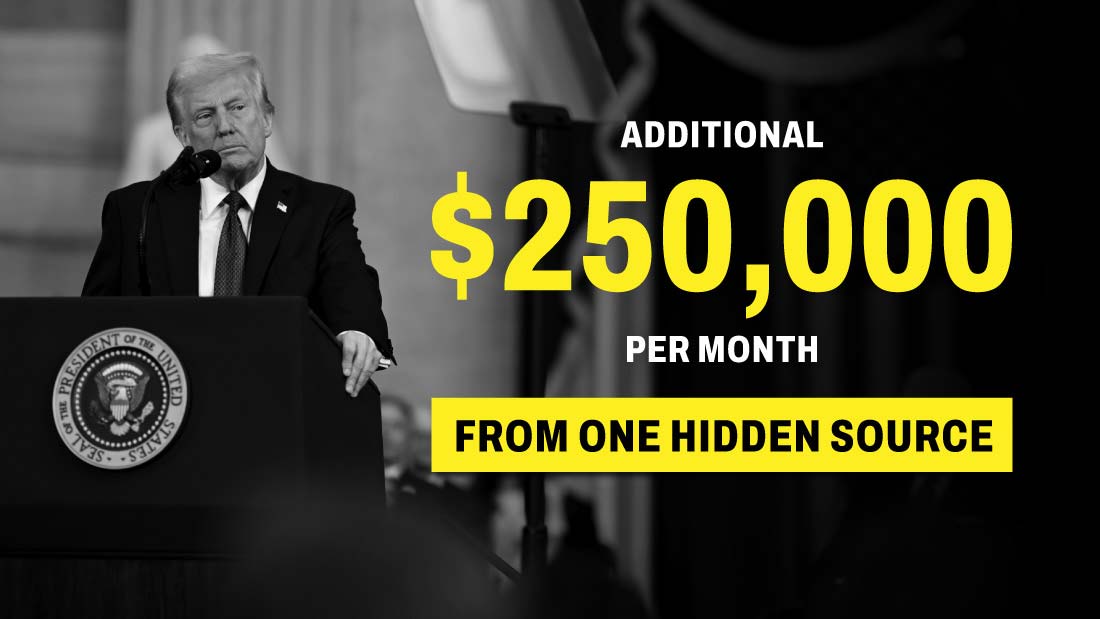 |
While President Trump's official salary is $400,000 per year... his tax returns reveal he's been collecting up to $250,000 PER MONTH from one hidden source. Until recently, most Americans couldn't touch the type of investment that makes up this investment. But thanks to Executive Order 14330, that just changed. If you love investing in disruptive new companies... Discover how to invest in the fund Trump uses to collect this income >>
Why This Matters Even If You Never Trade Currencies
A weaker dollar affects American households in ways that have nothing to do with foreign exchange accounts or investment portfolios.
Import prices rise. The United States imports a significant share of consumer electronics, clothing, automobiles, pharmaceuticals, and food inputs. When the dollar buys less in global markets, those goods cost more domestically. The grocery price pressures discussed in last week's issue — tariffs on fertilizer, packaging, and transportation — are partly a dollar story.
Travel costs more. A dollar that buys fewer euros, pounds, or yen means Americans traveling abroad face higher effective prices for the same trip they took two years ago.
Savings lose purchasing power in a specific way. Cash sitting in a savings account earning 4% annually looks attractive in nominal terms. If the dollar is simultaneously losing value relative to global goods and services, the real return on that cash is lower than the headline number suggests.
For investors with international exposure, a weaker dollar can work in their favor. When foreign assets are converted back into dollars, a lower dollar amplifies those returns. The U.S. Bank noted that the 2025 dollar decline actually lifted returns for many American investors holding international positions. That relationship also works in reverse when the dollar strengthens.
What Informed Investors Are Watching
The near-term question is whether the dollar stabilizes around current levels or continues lower. The June Fed meeting under new chair Warsh will be closely watched. A dovish signal — language suggesting rate cuts are coming sooner than expected — would likely push the dollar lower. A hawkish surprise would support it.
Longer term, the structural question is whether the combination of deficit spending, trade friction, and shifting global capital flows represents a cyclical episode or something more durable. Julius Baer analysts have noted that the dollar was significantly overvalued entering this period, and the recent decline has reduced — but not eliminated — that overvaluation. There is still room for further depreciation under the right conditions.
The 1970s offer a useful historical frame. The last time the dollar faced a sustained multi-year decline driven by fiscal pressure, inflation, and eroding global confidence, the adjustment process lasted nearly a decade and reshaped asset allocation strategies across every major investment category. Most analysts do not believe the current situation is that severe. But the direction of the forces is similar enough to warrant attention.
Understanding what the dollar does — and why — is not a specialized skill for currency traders. It is basic financial context for anyone trying to make sense of why prices keep rising, why their international investments behave the way they do, and what the Federal Reserve is actually managing when it sets interest rates.